
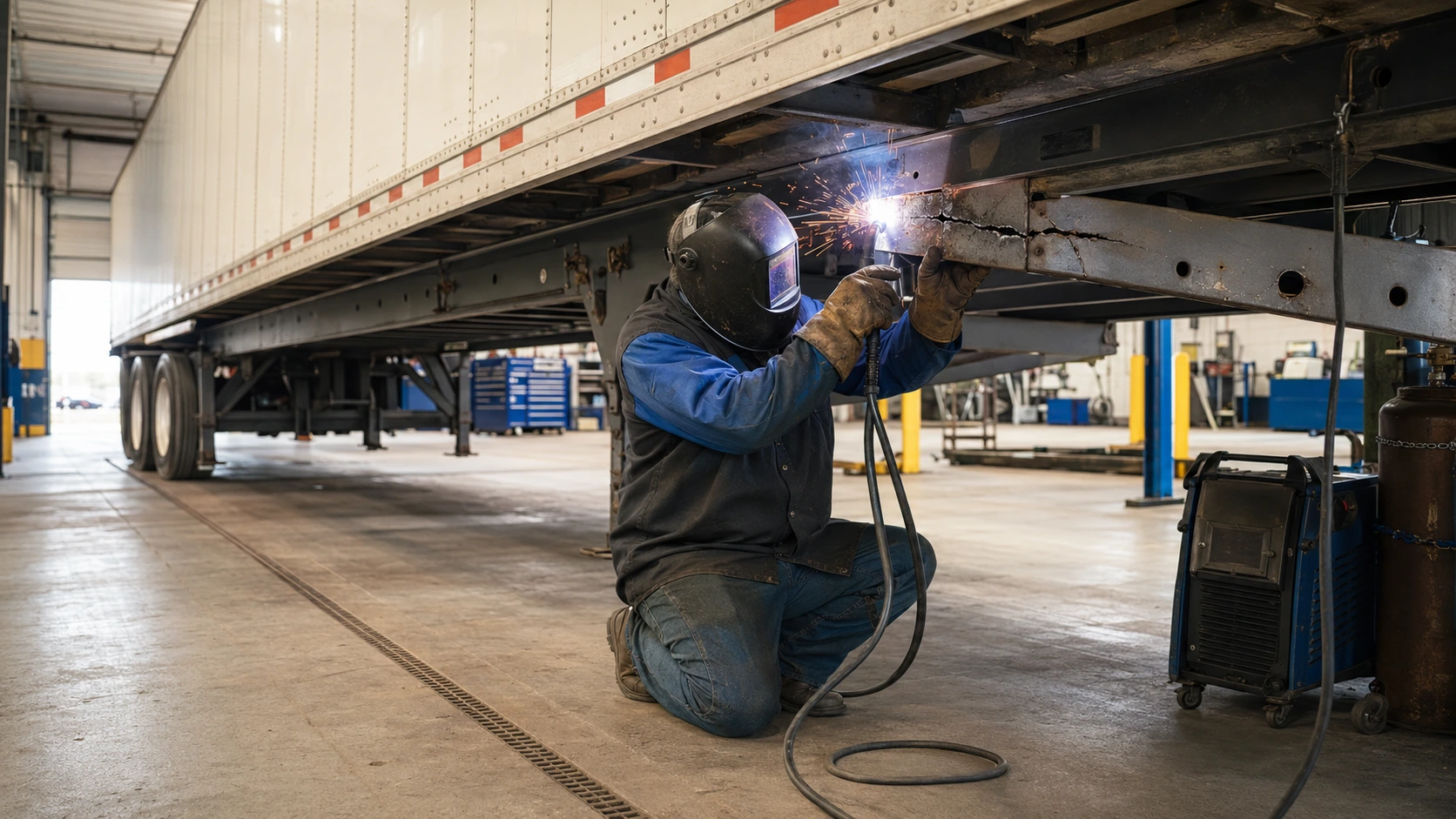
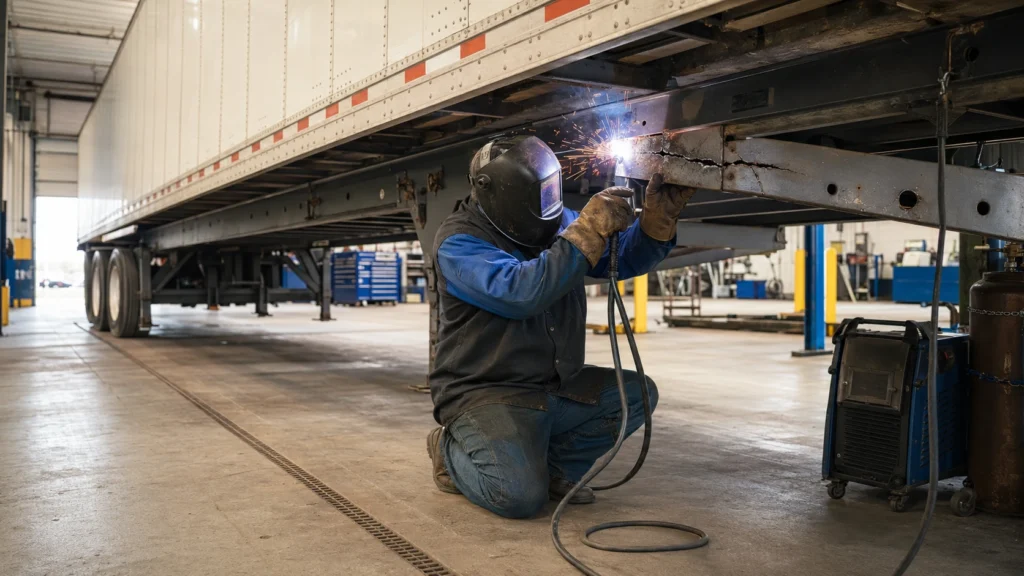
Commercial trailers operate under constant pressure. Heavy cargo, loading impacts, road vibration, Houston heat, moisture and everyday wear can weaken welds and structural components over time.
A small crack or broken bracket may initially appear minor, but continued use can place additional stress on the surrounding frame, floor, suspension or body components. Recognizing early warning signs can help fleet managers, drivers and owner-operators arrange an inspection before the damage becomes more extensive.
If you notice any of the following problems, your equipment may need professional trailer welding repair in Houston.
Why Trailer Welding Damage Should Not Be Ignored
Welds connect and support many important trailer components. Depending on the trailer design, welding may be present around the frame, chassis, crossmembers, rear structure, door frame, floor supports, mounting brackets and landing-gear supports.
When a weld or nearby metal becomes damaged, the affected component may no longer distribute weight and road forces as intended. Continuing to operate the trailer could allow cracks to spread, components to shift or nearby areas to become damaged.
Not every crack can be repaired using the same method. The material, thickness, location, previous repairs and extent of the damage should all be inspected before welding begins.
Technomech Trailer Repair provides trailer welding and fabrication in Houston for qualifying semi-trailers, reefers, dry vans, flatbeds and commercial chassis.
1. Visible Cracks Around Existing Welds
A visible crack near an existing weld is one of the clearest signs that an inspection is needed.
Cracks can develop because of:
- Repeated vibration
- Excessive movement
- Heavy or uneven loads
- Metal fatigue
- Corrosion
- Loading impacts
- Previous damage
- An earlier repair that is failing
Look closely around crossmembers, mounting points, rear frames, door frames, landing-gear supports and areas where different components meet.
Cracks may initially appear as thin lines in the paint or surface coating. Rust forming along a narrow line can also indicate that moisture has entered a developing crack.
Do not assume that welding directly over the visible line will correct the underlying problem. The damaged area may need preparation, reinforcement or partial replacement.
2. Broken or Separating Welds
A weld that has separated from the surrounding metal requires prompt attention. Separation may appear as a visible gap, lifted edge or component that moves when the trailer is loaded or operated.
Broken welds are commonly found around:
- Brackets
- Floor supports
- Crossmembers
- Door assemblies
- Landing-gear mounting areas
- Chassis components
- Suspension-related mounts
- Roof or side-panel connections
If the connected component is load-bearing, continued movement can increase the damage. The affected part and surrounding metal should be inspected to determine why the weld failed.
The correct repair may include removing the failed weld, preparing the base material and welding the component again. Damaged or weakened sections may require reinforcement or replacement.
3. Bent, Cracked or Damaged Crossmembers
Crossmembers help support the trailer floor, deck and cargo weight. They can become bent, cracked or separated because of overloads, impacts, corrosion and repeated commercial use.
Possible warning signs include:
- A floor that sags between supports
- Uneven trailer flooring
- Visible movement beneath the floor
- Cracks where crossmembers meet the frame
- Bent or twisted support sections
- Rust around attachment points
- Unusual sounds during loading
A damaged crossmember can affect more than the component itself. The floor, frame and nearby supports may also experience additional stress.
Depending on its condition, the crossmember may be repairable, reinforced or replaced with a fabricated section. A physical inspection is necessary before selecting the repair method.
4. Trailer Floor Sagging or Shifting
A damaged trailer floor does not always begin with the visible flooring material. The problem may originate in the supports beneath it.
If crossmembers, brackets or welded floor supports become damaged, sections of the floor may:
- Sag under weight
- Shift during loading
- Feel uneven
- Separate from the surrounding structure
- Develop gaps or raised edges
- Make unusual sounds under pressure
Dry vans, reefers and flatbeds can experience different floor-support problems based on their construction and operating conditions.
Floor damage should be assessed from above and below whenever possible. Replacing the visible floor section without addressing weakened supports may leave the underlying structural problem unresolved.
5. Damaged Door Frames or Rear Trailer Structure
Commercial trailer doors experience repeated opening, closing, loading impacts and contact with docks or equipment. Damage to the rear structure can prevent doors from aligning, sealing or operating correctly.
Signs of possible welding or fabrication needs include:
- Doors no longer closing evenly
- A roll-up door binding during operation
- Swing doors becoming difficult to latch
- Visible cracks near hinges or brackets
- A bent rear frame
- Gaps around the door opening
- Broken hardware mounting points
- Door components pulling away from the frame
The problem may involve the door hardware, frame, brackets or structural supports. Welding should only begin after identifying the cause of the misalignment.
A damaged rear frame may require straightening, welding, reinforcement, fabrication or replacement of qualifying components.
6. Loose, Broken or Missing Brackets
Brackets secure and support numerous trailer components. Even a relatively small bracket can affect the operation or position of the attached part.
Inspect brackets around:
- Landing gear
- Suspension components
- Lighting assemblies
- Air-line supports
- Door hardware
- Side skirts
- Storage or belly boxes
- Floor supports
- Chassis components
A loose or cracked bracket may produce movement, vibration or rattling. Missing hardware and elongated mounting holes may also indicate that the area has been moving for some time.
Depending on the application, the repair may involve rewelding the existing bracket or fabricating a suitable replacement. The surrounding metal should also be checked for cracking, thinning or deformation.
7. Recurring Damage Near an Earlier Repair
If a crack or separation returns near a previous welding repair, there may be an unresolved issue affecting that area.
Recurring damage can be associated with:
- Continued component movement
- Misalignment
- Unresolved structural stress
- Insufficient reinforcement
- Damaged surrounding material
- Incorrect material preparation
- A nearby component transferring stress into the repair
Simply adding more weld material may not provide a lasting solution. The repair area, nearby structure and operating conditions should be evaluated together.
Tell the repair shop about earlier work and provide any available repair history. This information can help identify why the damage has returned.
Aluminum vs. Steel Trailer Welding
Commercial trailers may contain steel, aluminum or a combination of materials. Each material requires suitable preparation and welding methods.
Aluminum Trailer Welding
Aluminum is commonly found in trailer panels, roofs, floors, flatbed components and body structures. It is lightweight and corrosion-resistant, but surface contamination and improper preparation can affect weld quality.
Aluminum damage may require:
- Cleaning and preparation
- Removal of damaged material
- Panel repair or replacement
- Reinforcement
- Fabrication of a matching component
Steel Trailer Welding
Steel is frequently used in frames, chassis, crossmembers, brackets and load-bearing components. Before welding, the technician may need to remove rust, paint, contamination or weakened metal.
Severe corrosion or deformation can make replacement more appropriate than welding the original component.
What Happens During a Trailer Welding Inspection?
A professional inspection generally begins with the visible damage, but it should also consider nearby components.
The technician may evaluate:
- The trailer type and intended use
- The damaged material
- The crack or separation pattern
- Nearby welds and supports
- Evidence of corrosion or earlier repairs
- Component movement or misalignment
- Whether welding, reinforcement or replacement is appropriate
For a faster initial conversation, provide photos, trailer details and a clear description of when the damage was discovered.
If the trailer is loaded, mention that before visiting. The load may affect inspection access or repair planning.
Can Mobile Trailer Welding Be Performed?
Some trailer welding repairs may be suitable for mobile service, while complex structural work is generally better handled at a properly equipped repair shop.
Mobile suitability depends on:
- The type and location of the damage
- Required welding equipment
- Safe access to the affected area
- Weather and surrounding conditions
- Whether the trailer is loaded
- The need for lifting or component removal
- Technician availability
Technomech’s mobile service may be available within approximately 25 miles. Call first so the team can determine whether shop service is more appropriate.
How to Reduce Future Welding Damage
Not all trailer damage can be prevented, but regular inspections can help identify developing problems earlier.
Fleet managers and drivers should consider:
- Inspecting visible welds during routine maintenance
- Checking crossmembers and floor supports
- Looking for fresh rust lines around welds
- Monitoring door alignment
- Inspecting landing-gear mounting areas
- Addressing corrosion before material becomes severely weakened
- Investigating unusual movement or noise
- Documenting earlier structural repairs
- Avoiding operation beyond appropriate load limits
A preventive-maintenance program should include the structural areas most relevant to the trailer type and operating conditions.
Choosing a Trailer Welding Repair Shop in Houston
Commercial trailer welding requires more than applying metal over a visible crack. The repair provider should inspect the surrounding area, identify the material and explain whether welding, reinforcement, fabrication or replacement is recommended.
Before scheduling service, ask:
- Do you work on commercial trailers?
- Can you weld aluminum and steel?
- Will the surrounding structure be inspected?
- Can you fabricate replacement brackets or supports?
- Is the repair performed at the shop or on-site?
- What information should I provide before arriving?
Technomech offers commercial trailer welding services in Houston, including qualifying aluminum and steel repairs, structural work and custom fabrication.
Schedule Trailer Welding Repair in Houston
Do not ignore a cracked weld, damaged crossmember, broken bracket or shifting trailer component. An inspection can help determine whether the damaged area requires welding, reinforcement, fabrication or replacement.
Contact Technomech Trailer Repair to discuss the problem and check current availability.
Technomech Trailer Repair
9346 Fairbanks North Houston Road, Houston, TX 77064
Call: (713) 420-9622
Calls are answered 24/7. Assistance is available in English and Spanish.
Frequently Asked Questions
Can a cracked commercial trailer frame be welded?
Some frame cracks may be repairable, but the appropriate solution depends on the crack location, trailer material, surrounding damage and structural condition. A physical inspection is required.
What are the most common signs of failed trailer welds?
Common signs include visible cracks, separating welds, recurring rust lines, loose brackets, sagging floor sections, damaged crossmembers and components moving under load.
Can aluminum commercial trailers be welded?
Qualifying aluminum trailer panels, floors, roofs, brackets and structural components may be repairable. Aluminum requires suitable preparation and welding techniques.
Should a broken crossmember be welded or replaced?
The decision depends on the extent of the damage, corrosion, deformation and surrounding structure. Some crossmembers can be repaired, while others require replacement.
Does Technomech offer mobile trailer welding in Houston?
Mobile welding may be available for qualifying repairs within approximately 25 miles. Complex structural or fabrication work may need to be completed at the Houston shop.
How long does commercial trailer welding take?
Repair time depends on the material, damage, fabrication requirements, parts availability and current shop workload. Call with photos and trailer details for initial guidance.